Thursday, April 17, 2014

Blog Número Doce: El Fin


So, this is super weird. I feel like the year shouldn't be over yet... not that I want it to continue longer but... Anyway, this class was so great because since it was a year-long class I really got to know a lot of you and made friends/connections. Being a commuter was difficult because I didn't have that aspect of college life, but this class gave me a little taste of it. And thank you to all of you who were in my groups for my final project for catering to my crazy schedule.
Honestly, I don't like history. Historical fiction, yes, history, no. So I really enjoyed this class a lot more than I thought I would, and part of that has to do with you guys and the professors. I loved the different activities we did, the Chicago trip, dancing... I wouldn't have minded if we would have done more of things outside of class (there's my "commuterness" coming out again!) I learned a lot in this class - about history and about college life/classes and how to get the most out of them, as well as balancing all the classes.
Thank you to all of you once again, have a fabulous summer, and don't be strangers next year!

Saturday, March 29, 2014

My Response to Jacqueline's Blog #11

Another September 11


Very interesting! The Remeber September 11 is spelled wrong... they forgot an "m". Random fact that bugs me now! :) Anyway, moving on... I like your analysis of the picture! I would add about Allende that if he was pointing the gun at himself, what would that show? Not much faith in what he stood for. Suicide is the easy way out, and you wouldn't want to proclaim that is what you did/what you would be doing to your supporters. I think the fact that he is aiming the gun shows he is at the "soldiers" and his supporters level. He too is fighting with them. He isn't just a leader that directs, but is one with the people, which goes quite well with his message! Great blog post!

Friday, March 28, 2014

Blog Número Once


Gioconda Belli's: In the Language of Memory


I quite enjoyed this poem, especially compared to Neruda's. I have no doubt Neruda was a talented poet and his poem meant a great deal of things, but I just didn't get a whole lot out of it. Belli's poem, on the other hand was very vivid. I love her description of events and the impact it had on society. I don't know how many of you researched some of the words she uses, but here a couple ones that stood out to me.


Native Words:


Quequisque: is a tuber that is mostly used in soups. It is found in many Latin American countries, but each country gives it a different name. Quequisque is the Argentinean name.

Yuca: is like a potato as well, and used in soups as well as other dishes


Quequisque
Quequisque is in the lower left, and yuca is above it.


Jipijapa: is a type of palm tree as known as the Panama hat tree. It isn't a true palm because it doesn't have the bark trunk. It has soft, flexible, durable fibers that are used to make Panama hats or other objects like baskets as described in the poem.


Ceibos: is a huge tree that some species can grow up to 230 feet tall or more. It has straight branchless trunk and a spreading canopy as well as large buttress roots. There is a  legend associated with one species of the ceibo tree found about an indigenous woman.


Quena: is the traditional flute of the Andes. It is kind of similar to the recorder, which most of you probably played? except that you rest the mouth piece between the chin and lower lip and blow downward to create sound. Unfortunately, I couldn't get a video to upload, but go to Youtube and look up the quena!
Have a great weekend everyone!


Saturday, March 22, 2014

My Response to Jacqueline's Blog #10

I completely agree! I find it amusing in an odd way of how Posada depicts her. It's very ironic that she is a skeleton with a big fancy hat. I agree that what you do with your life is more important than money. There's a quote: "People don't remember what you say or what you did, but how you made them feel." It doesn't matter how much money you have, or what clothes you wear, its the impact on people around you that matters. Money doesn't buy happiness. People who think earning a lot of money will make them happy are very off track. Sure it is nice, but you don't have a good grasp on the meaning on life if money is distracting you.

Blog Número Diez


Copper


I don't know about the rest of you, but I had no idea how you would mine copper. I expected it to be quite simple with a bunch of machinery, but really there are a lot of different processes and techniques that can be used. I did a little bit of research and came up with some interesting tidbits and a couple processes which I briefly describe.

First off some interesting facts about Chile today: Chile has about 24% of the world's copper reserves, and Chile's mine, Codelco, is the world's tope copper producer. In 2010 Chile produced 5,390 metric tons of copper.

Copper Mining:
There are various copper extraction techniques which I'll give a brief overview of.
The first stage: the rock containing copper is crushed into small particles. This process is called accurate grinding or comminution. The particles are then separated to remove the gangue (minerals such as silica, magnesia, alumina, and limestone), then by physical liberation where the ore minerals are separated from the rock.
 
If the copper ores are an oxide ore: then a hydrometallurgical liberation process is undertaken. Big word, yes, but actually isn't that difficult to understand. Hydro - means water. So pretty much this extraction uses aqueous chemistry to recover the metals from the ore. This is only possible because of the soluble nature of the minerals.


If the copper ores are sulfide ores: a froth flotation process is used. This is a modern technique that was invented in the early 1900s in Australia. The froth flotation is a complicated process - in a nut-shell depending on the ore different "frothers" are used in order to bring the ore to the top of the cell which is then pumped out. If you are interested in the chemistry of it - go look it up!

This is a copper sulfide foam in one of the froth-flotation cells.

This is an example of what a froth-flotation cell would look like. It takes special machinery, which is why many jobs were lost in Chile as this took over.


After the ore has been removed the copper sulfide is smelted. The purpose of smelting is to eliminate the unwanted parts such as iron, sulfur, and the gangue minerals. This produces a matte. Now they would have copper sulfide. The sulfur is then removed at a high temperature as sulfur dioxide by blowing air through the molten matte.
For all you chemistry people out there here's the equation.
2CuS + 3O2 ---> 2CuO + 2SO2
CuS + O2 ---> Cu + SO2
It is then refined in a furnace or by electrolysis.

And...this is only part of the process of refining copper from ore. Hopefully this blog gives you a little insight into copper mining and how complex it is!


Monday, March 17, 2014

Blog Número Nueve


The South: A different take on Civilization vs Barbarism


So we had a really great discussion on Borges's The South. I think we all agree that there was a difference between Dahlmann's self in the city and the country. I found it interesting that while he was in the city, he yearned for the country and the ranch. After he leaves for the ranch, you kind of forget about the city, but he always has a part of the city with him, his book - the Arabian Nights (or One Thousand and One Nights). But he eventually forgets about the book as he is caught up in the countryside, and he leaves the city behind. The city is similar to civilization and the South is the "barbaric" part of the country.
This brings a thought to my mind. Every person struggles with civilization vs barbarism.There is that side of a person that yearns for civilization, for cities, and people. Elegance, a higher form of life. The strength of this is different in each person, just as the barbaric side is. The barbaric side is the side that pulls Dahlmann to the country. He seeks quiet, tranquilly, adventure, a valiant death. Who would choose a death on a hospital bed over a death defending your rights or your beliefs?
Now, back to the story. Dahlmann had lived in the city his whole life. In a way, he had fulfilled that "civilized" part of him and his "barbaric" side was pulling him toward the country. That, combined with the fact that he didn't want to die a death in a hospital bed, was why he took the train out to the South.

I was hesitant to use the words civilization and barbarism - though for the sake of clarity and lack of 2 opposite words that are similar I did. 

My Response to Elena's Blog #9: Balthazar and the Biblical Magi

I find this connection super interesting! I thought of Belshazzar - a King in the Old Testament when I read the story at first. If you are familiar with Biblical history he was the King who saw the writing on the wall, had Daniel interpret it, and died the next day. I almost find that a closer representation than Balthazar, one of the wise men. Belshazzar is also sometimes called Balthazar. Interestingly though, the number of Wise Men is unknown. People just assume it is three based on the three gifts - one per person, and of course that has been passed down as tradition and depicted in pictures and books, but is not historically correct. There is actually another tradition as well that says there were 15 Wise men that came. Thought I'd pass that knowledge on, seeing as I just found out we don't know for sure how many Magi there were this last Christmas!

Thursday, March 6, 2014

My Response to Grace's Blog #8

Horacio Quiroga 


Awesome blog! Thanks for this interesting post! It is no wonder his stories were about death and despair if his life was like that! I wonder if his fascination with the jungle stemmed from this as well. There are wild animals and few people. Seeing as all those who were close to him died and/or committed suicide, he may have blamed himself. That is the sad thing about suicide - it oftentimes hurts those who are still living more than the person that commits suicide. Younger children, especially, tend to blame themselves. He may have found an escape in the jungle.

Blog Número Ocho


Zapatista Mural

I was just in Chicago yesterday, and unfortunately didn't have the time to visit some of these Murals at the Latino Cultural Center. But as I was researching it, I came across this mural, The Zapatistas. Having the discussions about the Mexican Revolution and murals has really opened my eyes, and now I actually get something from looking at a mural/painting. 


This mural is quite self-explanatory, especially to all of us because we have just gone over the information about the Revolution and Emiliano Zapata. There isn't a lot of information about this particular mural, so I am going to divulge into a short interpretation of some of the aspects in this mural.
The watch: I would think a timepiece would not be a very common object in a Zapatista's household, and the fact that is quite prominent in this mural is interesting. It may be because time was something that was important, yet not a huge aspect of their life. They didn't live on a schedule, but the timing of their attacks with the other Revolutionary leaders was what enabled them to win. 
Notice in the lower right hand corner it looks like waves. Rough waves. The color is dark - navy blue. This color is also expanded into the upper right hand corner. This is a huge contrast to the seemingly bright blue sky in the left upper hand corner. Just by the way the painting is focused, it seems as if it is showing that the Zapatistas came from a stormy, tumultuous background, spurred on by their passion to have a voice. Their history is not a smooth ride, they struggled to survive as their lands were taken away. But there is hope in the future. Clear sky is ahead; smooth sailing.

What do you think the object in the lower left corner is? It's bright colors and "grin" just doesn't seem as if it fits in such a somber painting...


This is also a mural that I found intriguing.

El Corazon


It is a heart with flames that signify love and passion. According to some American Cultures, the fire in a heart drove warriors in battle, which is signified by the arrow.


Saturday, February 22, 2014

My Response to Alexis's Blog #7

Great blog! I love how you made those connections to their song! :) I think Demetrio was in the middle of what both of you, Grace and Alexis, are saying. Demetrio, obviously, didn't take in as much of the looting and sexual assaults as his men did, but yet, Grace, you have a good point. But you have to remember that someone burned his house down. Now, I'm not saying that it is right to take revenge,  definitely not! I think Azuela is getting at 2 different viewpoints during this scene. As you said, we don't know if the family is still inside. The hopeful side of the reader would say, no they were able to get out. A house takes a while to burn down. But yet, the revenge side of the reader wants them to suffer. But I would also agree in a way. If he truly wasn't like his men, why didn't he stop it? Why didn't he control the looting and violence? Set standards? He was the general. But then again, Azuela is trying to portray what happened during the revolution. So, I guess, I don't really know how I view Demetrio. I see him as the hope of the revolution, the foundation which everyone else veered off from. He was wrong, and he was right.

Blog Adicional - The Piano Guys

The Piano Guys
Steven Sharp Nelson
and
Jon Schmidt
 
 
It has been brought to my attention over this Friday that the majority, if not all, of the Latin American Civilization class is missing out on some very important, fabulous music. If you don't care for how instrumental it is (seeing as they are all covers) you have to admit that they have some phenomenal talent! And my apologies that this is completely unrelated to Honors! Besides that fact that you well-rounded people should have known about them! :)
 
For all you Frozen lovers out there! 
 
Yes, it is One Direction.... but it's 5 guys, and 1 piano.
 
 
My personal favorite!
 
 
Enjoy the music! And go check out their other songs on Youtube! They have some pretty crazy videos! 


Blog Número Siete


Henequen
 
During the Porfiriato, Mexico became a lot more export orientated then they had before. Although at first glance, this may have seemed like a good thing, it didn't benefit a whole lot of the Mexicans. It benefited the foreign investors and a few elites. Some of the other major exports during this time period were coffee, sugar, rubber, vanilla, and minerals, which we all know something about, but henequen is something that I thought was worth a little research. Sisal is the most important plant in the agave family for its fibre, and then Abaca. Henequen is third.
Henequen is native to Mexico and is also sometimes referred to as Yucatan sisal.
 
The plant stalk of henequen is a grayish green, as can kind of be seen in the picture below. It grows up to 6 feet in its wild state, and about 3 feet when under cultivation. The leaves can get up to 4-6 inches wide.The leaves can get up to 4-6 inches wide.
 
henequen
 
Here henequen is getting prepared for rope. First the fibre is often freed by a machine by curshing the leaves between rollers and then scrapes the resulting pulp from the fibre. Afterwards, the strands are washed, dried in the sun, and brushed.


Henequen has fairly good strength, not as strong as Sisal or Abaca though. They are flexible and are resistant to microorganisms that would break them down in saltwater. It is mostly made into twine that is used in agriculture and shipping, but can also be made into rope.
 
 
Have a great weekend everyone! And go check out my "extra" blog this weekend! :)


Saturday, February 15, 2014

Blog Número Seis

 
Do Revolutions End?
 
According to the Merriam-Webster Dictionary, the definition of a Revolution is as follows:
 
: the usually violent attempt by many people to end the rule of one government and start a new one
: a sudden, extreme, or complete change in the way people live, work, etc.
: the action of moving around something in a path that is similar to a circle
 
 
The Mexican Revolution is directly related to the first definition. It was an attempt to overthrow the government and start a new one, violently. We've seen this in the movie Viva Zapata and in Professor Stark's lectures. It was violent, bloody, a success and a failure at various points throughout the revolution. In Viva Zapata, it ends with the quote: "If we ever need him again, he'll be back." This is talking, literally, about Zapata's horse, Blanco. But how would Blanco help them? Blanco is symbolic of Zapata and what he fought for. Blanco is the living symbol of the revolution. 
Earlier on, as the president was discussing what to do with Zapata, Fernando says "Cut of the head and the snake will die." Although Zapata is the leader, he isn't the complete driving force behind the revolution, so this won't work. Cutting of Zapata would simply be giving the people a martyr to revenge and to fight for.
The ideology of the Mexican Revolution is passed down from generation to generation. The history is never forgotten, and so the revolution never dies. When something as significant as the Mexican Revolution happens, it is not just thrown away and forgotten. It is learned from, taught to the next generations, and used as the force to drive new ideas, and new revolutions.
In our own country, take 9/11 for example. We learned from the terrorist attack. It has been 12 years, and we haven't forgotten. We still fight terrorism. Whenever there are martyrs or an event that sweeps and impacts everyone in a country, it is not easily forgotten. It is our history, who we are. We learn from our mistakes so we don't make them again, because history repeats itself.
 
I instantly think of the Industrial Revolution in the early 1900's when I read the second definition. Drastic changes to the workplace and living conditions. Did this ever end? I believe the Industrial Revolution is still happening today. Changes are still being made, it just isn't as significant today as it was during this time period. We never stopped industrializing, it continues still today.
 
Finally, going down to the root of the word, a revolution is a circle. A circle never ends. So, a revolution never ends. The path a revolution takes may vary slightly, but it still keeps going. Revolutions as ideas continue as long as there are people who know and believe in the idea. They may eventually fizzle out, but because we are taught history they can always be resurrected.
 
Have a great weekend everyone! 2 more weeks until Spring Break! :)

My Response to Grace's Blog #6: Emiliano Zapata


I thought of Robin Hood as well! I don't know if you've seen the animated version, but here is one of the songs. Though I'd share it, love this movie! :) The puppet on a string reference I think is a good one, not necessarily to Diaz, but to the other presidents during the Mexican Revolution who were no more than puppets.
I would say Zapata is more democratic than communist. He definitely seems communist at first glance, but since the lands were already the peasants and taken away, he is just giving back what is rightfully theirs. Additionally, he wanted the people to have a voice, which is democratic.

Saturday, February 8, 2014

My Response to Jacqueline's Blog #5: Marti

This is incredibly interesting! I must agree that I find it quite annoying that my ethnicity is asked for everywhere I go, and because I am white I am actually discriminated against. I can't apply for certain scholarships because I am not a minority, but there are not any scholarships out there that are "for whites only" - because then people would think that was discrimination. What's the difference?!
That is so interesting about the rugby team! It shows that anyone can be united if they fight together! That is how America became how it is - because the colonies united and we shared a common goal, and perhaps we should have stayed out of other countries so they could learn that lesson on their own as well.

Blog Número Cinco

 
The Seven - League Boots

I have never heard of the Seven-league boots as mentioned in Jose Marti's "Our America". It piqued my interest, and I did a little bit of research and found this story. There are many other stories that include the Seven-league boots, but this is a popular one! I know this post looks long, but it is a great break from writing your paper!
 
The story of the Seven-League Boots is in many European folk tales, but is quite common in the following French story. This story, as you are reading it, sound a lot like the childhood tale you probably grew up with - Hansel and Gretel, except with some differences that I'm sure you will see. (I'm not going to give away the story!)
 
 
"A VERY poor couple once lived in a village near a wood, where they used to work ; but as they had a family of seven little children, all boys, they could hardly manage to get food enough. The least boy was so tiny that he was called HOP o' MY THUMB ; but though so small, he was very clever. One night, when all the children were lying in bed, their parents were crying sadly, because there was no food in the house ; and Hop o' my Thumb was quite in a fright, when he heard them say, that they would take all their little ones into the wood next day, and there leave them, that they might not see them die of hunger. So he got up very early in the morning, and filled his pockets with pebbles ; and when he and his brothers went into the wood, he dropped the stones one by one as he walked along, and by this means, when it was getting dark, they found the way home again. But the next time the poor couple took their children to the wood, the little fellow could not get pebbles, for he had been locked up all night, and had nothing but a few crumbs to drop on the road, and these the birds soon ate up. The wind howled, and the rain fell, and the poor children thought they should all perish ; but they still kept moving on, in the hope of getting help.
Hop o' my Thumb kept a good look out, and at last he saw light not far off. So he cheered up his brothers, and on they went, till they reached a large house, from which the light was seen to come. After they had knocked at the door, a pleasant-looking dame opened it ; and Hop o' my Thumb told how they had lost their way in the wood, and were very tired and hungry. As soon as she heard their story, she told them to go away as fast as they could, because her husband, who was an Ogre, and very fond of eating children, would soon be home. But they all cried so much, and begged so hard for food and shelter, that at last she let them in.
The Ogre's wife had only just time to hide the poor children, when the Ogre came in, and ordered her to lay the cloth, and bring in some sucking-pigs for his supper. Just as he began to use his great carving-knife and fork, he cried put gruffly, " I smell child's flesh I" His wife said it was only the freshly killed calf ; but he was not to be put off so easily, and, on looking about, he found the poor boys under the bed. The Ogre gave a look of fierce joy when he saw them, but he thought it better to fatten them up before he killed them ; so he told his wife to give them some supper, and put them to bed, in the same room where his daughters were sleeping.
Hop o' my Thumb, fearing mischief, could not sleep ; so he got out of bed, and, on looking about, saw that at the Ogre's daughters all had crowns on their heads; he then changed these for the nightcaps worn by his brothers and himself, and when the Ogre came up in the dark, with his great knife to kill the poor boys, he cut the throats of his own children, instead! At peep of day, Hop o' my Thumb awoke his brothers, and made them quickly get away with him from the house. After they were gone, the Ogre, grinning savagely, went up to the bed-room ; but he became almost mad when he found he had killed his daughters, and the little boys were all gone.
The Ogre now put on his magic boots, with which he could take seven leagues at a stride, and set off in pursuit of the poor runaway boys ; but Hop o' my Thumb had made them all hide in a hole under a rock. By-and-by the Ogre came back tired and in a very bad humor, and threw himself on this very rock to sleep. A kind Fairy now appeared to the children, and gave Hop o' my Thumb a nut to crack as soon as he should reach the Ogre's house ; but the Fairy told him he must first take off the Ogre's boots, and send his brothers home, and afterwards put on the magic boots himself, and make the best of his way to the Ogre's house.
Hop o' my Thumb, with the help of the kind Fairy, soon removed the Ogre's seven-leagued boots while he was asleep, and put them on his own little legs ; but as they were magic boots, they fitted him as well as the Ogre, just, indeed, as if they had been made for him. He now called his brothers out of the hole in the rock, and put them in the way to reach home. He then strode on in his magic boots, till he came to the Ogre's house, and, on cracking the nut, he found inside a paper with these words :
"Go unto the Ogre's door, These words speak, and nothing more; ' Ogress, Ogre cannot come ; Great key give to Hop o' my Thumb.' "
When the Ogre's wife first saw Hop o' my Thumb, she was ready to kill him for having caused the death of her daughters ; but no sooner did he utter the magic words " Ogress, Ogre cannot come ; Great key give to Hop o' my Thumb."
Than she gave him the key of the gold chest, and told him to take as much as he chose. When he saw the great heap of money in the chest, he thought, like a good subject, he should like to help the King to some of the treasure ; and so he made the Ogre's wife give him as many bags full of gold as he could take away in several journeys.
While Hop o' my Thumb was so well employed in taking away the wicked Ogre's treasure, that monster was still sleep- ing, after his useless journey in search of the poor children, on the rock, where Hop o' my Thumb left him. When he awoke, and found his magic boots gone, and his limbs so stiff that he could not move, he made a hideous noise, which aroused all the wild beasts of the forest, and they all flew at him in great fury, and gored him to death.
 
Hop o* my Thumb now went to Court, laden with his hard won spoil, and paid his respects to the King, who did him the favor to accept of his rich gifts, and rewarded him by making him his Head .Forester, and his father and brothers foresters under him ; and whenever the King went out hunting, the little fellow used to ride by his side, on a pretty, high-spirited little horse, with rich velvet clothing. The Ogre's kind-hearted wife was also invited to Court, and created Duchess of Dollalolla ; and she shared the rest of her husband's wealth with Hop o' my Thumb, who was greatly beloved by all for his spirit and good sense ; indeed, his Majesty at last dubbed him a Knight, and made him his chief Privy Councillor, saying, that as he had been always so shrewd and clever in helping his brothers, he must surely be able to give him good advice whenever he might need."
 
Where I got the story:
If you have the time and like myths - check out this site!
 
Buena suerte on your papers!

Saturday, February 1, 2014

My Response to Elena's Blog #4: The Image of Cecilia Valdes

This is really great! I love how you described it as an allusion and extended metaphor. I kind of caught on to the image of Cecilia being portrayed as the whole society, but not to the extent you took it! Cecilia was a mulatto that you can relate to a certain sense with because it is a novel, and it is interesting to think that all the mulattos were like that/extending her to all of society. Would you say all the characters are part of an extended metaphor? Leonardo is definitely a metaphor of white men in society. What do you think about Nemesia? Do you think she is just for the background basis to make the novel seem more real?

Blog Número Cuatro


Slavery Today


Slavery has impacted our world for ages, it still does, and I believe, unfortunately, it always will. Either having slavery itself in some part of the world, undercover, or the consequences of slavery from the past, it changes who we are, our values, and what we stand for. We must step forward and voice our beliefs, because too often, as we see in Latin America, it is the small minority that rules the majority, only through a larger voice and a "higher" culture.

Look at the struggle in Jamaica. Slavery was good, wasn't it? Shouldn't people be private property? Can't we do whatever we want to them? The government shouldn't be able to tell us what to do, we have a choice. This was precisely the argument slaveholders made. But many people disagreed, and I think most of us disagree as well. Slavery should be abolished. The slaves should be taught to read, write. They had a right to freedom, to live with liberty, and to follow their dreams!
 
File:BLAKE10.JPG
 
 
Slavery slowly became abolished in many countries throughout the centuries, but just because Brazil was the last country in the west to abolish slavery in 1888, it doesn't mean that slavery still doesn't exist today.
 
Think of the Middle East. Women, who have no rights, can't walk on the streets without a man, can't drive a car, must always have their full body covered, are beaten if they speak out or refuse to accept a man, must share their husband with other women, and obey him no matter what he says or wants. Is that not slavery? Should a human being, a person, someone with a voice, a right to live, to choose, and to be happy, be treated this way?
 
Think of human trafficking. People, who are sold for their bodies, for their labor. I think specifically of sexual slavery. What person, either man or woman, should be subject to something like that? To have their body sold to another. Aren't they too, a human being, a person, someone with a voice, a right to live, to choose, to be happy?
 
What about child labor? This is still prevalent in third-world countries. These children are forced to work, deprived of education, their childhood, memories, play. These are kids! Imagine your childhood. Do you smile? Erase it all, and replace those fond memories with trudging off to a factory or a field every day. They are forced to work, have no choice, cannot refused or else they are beaten.
 
Think about the Holocaust. Was not that slavery? So often we think of slavery, as a person of another race or an "inferior" person who is easily persuaded by physical or mental means to benefit another. One of the Merriam Webster definitions of slavery is: "submission to a dominating influence." The Jews, the handicapped, the gypsies. 11 million, (11,000,000) innocent people, with nothing but a different religion or view on life, were killed. To try and put this in perspective, Ohio has around 11.5 million people, and Michigan has 9.8 million. The Holocaust, if brought to Michigan, would wipe out the entire state. Because why? Because we are inferior. Because you are a Jew, a gypsy, someone who stood up for your neighbor, for your friend that was being beaten or taken away. Because you hid people, to save their lives. Because of this you are taken to a concentration camp. You don't know what to expect. It is simply new living quarters, until your little sister or your skinny frail brother is taken away, and you never see them again. Until you realize that the outbuildings are not holdings for food, that the shots being fired are not the killings of animals, that the guards are not there for your safety, nor are the high fences there to keep other things out. They are the gas chambers, the killings of your neighbors - the boy you met in the train car you were packed in to get to this awful place - the guards are there to beat you and make you work, the fences to keep you in. Is that not slavery? Don't you have a right to live?
 
What if I was to tell you of another Holocaust, and a true holocaust, a "sacrifice by fire", that is happening again today. Everywhere. In Asia. In Australia. In Europe. In Africa. In South America. And in the United States of America, where every person has the right to "life, liberty, and the pursuit of happiness", would you believe me? Would you tell me to stop it before it impacted your life? If people were being burned, torn apart limb by limb, and didn't have any say about it? What if I said that these people never spoke out against dying a cruel death, that they never refused or tried to uprise and stop the injustice, would that make it right? If all they did was squirm and were unable to make a sound, a peep, a scream, say no, beg for life. If you don't have a voice, does that make you not human?!
 
Take 11 and multiply it by 4.5. Than add the unit 'million'. That is how many innocent lives have been killed by abortion. And this number does not include the deaths of the mothers after abortions. Is this not slavery? Aren't the babies submitting to a dominating influence? You say the mother has a choice, that is her child, her body, that the killing is okay if it still is inside the womb, but once out of the womb, it's murder? Have you ever listened to a baby's heartbeat in the womb? Feel it kick the mother's side? See the love in her eyes as she tells you about her little baby girl or boy? Have you ever felt sick after learning you may have had a little brother, sister, niece, or nephew, but the baby died in a miscarriage? Do you mourn that life? I mourn every life lost. Whether it was a baby I could have held someday, a friend I would have now, or a baby thousands of miles away. One killed because it was unwanted, not planned, just a nuisance. Things in life happen that we don't want. No one wants cancer, heartbreak, the death of a loved one. We don't plan those out in our lives or prepare for them. Many things are a nuisance, but compared to precious life, these petty things that come to mind are not much. I don't just mourn every life lost, but every life affected. The heartbreak or the guilt. Those who walk away with a smile on their face, who think they just did the best thing in their life. But I can tell you, there aren't many like that.

Is not abortion oppression? A form of slavery? Is it better to murder than to beat? Better to die than to live? Is anyone truly unwanted? No. Every life is precious. Every life is a gift. Every person, everywhere, no matter the color of their skin, their talents and abilities, their physical characteristics is wanted. You and me are wanted, loved. And those babies are too.


Am I not a child and a daughter?
Am I not a child and a son?
Do I not have the right to live?
The right to liberty?
To my happiness?
To grow, laugh, cry
To struggle, make choices, have friends
To make mistakes, to apologize
Am I not a slave?
Am I not a human being that has yet to reach my potential?
Am I not just a baby, without a voice?
Do I have no right to speak my choice?
But if I am killed before I can say
What my choice would be
Does that make it alright?


Thank you for reading! Enjoy your weekend everyone!

Saturday, January 25, 2014

My Response to Grace's Blog #3

"Cowboys and Sherlock Holmes"
 
 
This is great! I love you how applied the reading to something you have encountered/ like! It is interesting how many things in the readings cause us to think of things completely "unrelated" to the material, but upon further investigation we can find relationships. I have not seen Sherlock Holmes, (read one of the books), but this looks really good! :) Love the comparison between the gauchos and Holmes!

Friday, January 24, 2014

Blog Número Tres


I love music. Any kind. My favorite is pretty much anything with a beat, and especially orchestral covers of popular songs. I have a very strong preference for string instruments, seeing as I play both violin and cello, so when in Sarmiento's Chapter 2, I came across the musical aspect (on page 63), I did a little research I would like to share.
The Argentina's were known for their musical abilities. Sarmiento says, "When an Argentine is presented at a home in Chile for the first time, he is invited to sit at the piano immediately or they hand him a vihuela... because being an Argentine, he must be a musician."


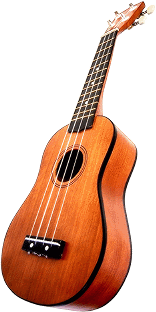
A vihuela is very similar to a guitar and lute. The curving sides were made so that they could be played with both a bow (de arco) or with fingers (de mano).


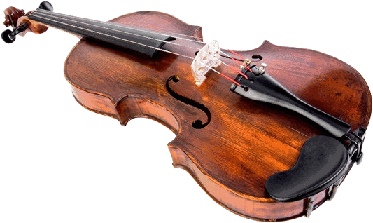
But after the late fifteenth century, a short bridge was introduced, and therefore made playing with a bow impossible. For those of you not familiar with stringed instruments and their components - just look at the bridge differences between the violin and guitar. The guitar's bridge is flat, making the strings all equal which allows someone to easily strum the strings in a smooth downward motion. The violin, however has a large curved bridge, making the strings slightly curved. This allows the bow to only hit one string at a time. If the bridge was flat, you would not be able to hit only one string at a time.


Acoustic Bass GuitarViolin


The Vidalita was a popular song, that was actually song. The video below doesn't have the chorus (I unfortunately couldn't find one with words) and is a little shorter than most versions of Vidalita. This song originated with the indigenous people, but became a popular base for bards and cantors, to which they would put their own words and stories. 


For more history and descriptions on the vihuela, check out this site: http://cs.dartmouth.edu/~lsa/aboutLute/Vihuela.html
 
Have a great weekend everyone!


Monday, January 20, 2014

My Reaction to Alexis's Blog #2

I completely agree with the irony and your thoughts on the situation! That is a really good connection! I would add, however, that the difference between the two, is that in America the wealthy attained their wealth by hard work, not because they were given that place in society because of their background. (The only slight exception I can find is celebrities. But yet in that elite society, it still is talent and hard work that gets you in...) I think that may have been one of the reasons the people in Latin America found fascinating about the U.S., is the ability to start from scratch and make your way toward wealth and higher society. 

Saturday, January 18, 2014

Blog Número Dos


For this blog post, I have some questions and my own person answers, but I really want to here from you. What do you think?

1) The majority of this week we have talked about nations. And what really brings up the following question is in Sarmiento's Chapter 1. As I was reading it, I was trying to find whether or not I have a biased on who is civilized and who is not. Throughout our highschool careers, we've talked civilized versus barbarism, the Indians who the settlers thought were barbarians, and have talked extensively about the same issue in South and Latin America in this class regarding the Aztecs, Mexicas, and Incas. We've talked about what defines a civilization, but on the flip side what defines a barbarian?

2) Another question from Sarmiento's Chapter 1 was one I related to Burns' writing. In Burns', you'll remember that he talks about how the ideology of the elites was shaped by the enlightenment among other things. The idea of the enlightenment was that if people had the opportunity to know the truth, they would select "civilization" over "barbarism". Sarmiento makes a comment in his chapter that "Civilization, then, can never be attained, barbarism is the norm..." But if this was the days of enlightenment, why didn't they try and erase that ignorance and change the barbarism to truth?


My Answers:
1) I personally, believe there are higher and lower forms of civilization, but they are all civilizations. People were created equal. The reason Europe became so "civilized" and advanced is all because of how we viewed it. We have been able to study the society of Europe from the beginning of time, but not that of the New World societies. In order to see how far something has advanced, you need a starting point. If you are measuring the length of a pencil, you need a start point and an end point. With no distinct starting point for the New World societies, I don't think anyone can come up with a true analysis of how far these societies have come. So I don't believe there are barbarians. No matter what race, gender, social structure, religion or culture a people has, they all possess intelligence and have the potential to become something better, to improve. Some improve slower than others, but there are many factors that go into progress so I'm not going to go into that. :)

2) In the context of this excerpt, he mentions before that the culture of intelligence was neglected in the [Arab or Tartar tribe] and is not only neglected but impossible because if they were to implant a school, would children from ten leagues (about 34.5 miles) away  come to attend? There is the same issue with the church. Because the people are so spread out in many directions, they cannot decide on a proper place to build a church or school so that people would actually attend. So in this context, I can kind of see where this comment came from. However, I still don't quite understand why, in the enlightenment idea, that they didn't not build churches and schools in various spots and believe, since it was the enlightenment idea that you would pursue civilization if the chance was handed to you, that people would come and attend in the pursuit of knowledge and civilization.

Feel free to answer my questions, or question both my questions or answers! :) Enjoy your extended weekend, everyone!

Wednesday, January 15, 2014

Blog Número Uno

First, about myself. I'm Leah, I'm a commuter, my major is Biomedical Science and my minor is Spanish, and I will probably end up minoring in Chemistry as well. I am going for a Physician Assistant, specializing in pediatrics or surgery.
I chose Latin American Civilization because I enjoy studying Spanish and Spanish history. I took 2 years of Spanish at Plymouth Christian Highschool which was all that was offered. It is my dream to study abroad, still deciding where, but either a 3rd world country or Spain. Another reason I choose Latin American Civilization is because I hope to go down to Bolivia this summer on a mission trip, and in the future, hopefully to Mexico and other Latin American countries.