I love music. Any kind. My favorite is pretty much anything with a beat, and especially orchestral covers of popular songs. I have a very strong preference for string instruments, seeing as I play both violin and cello, so when in Sarmiento's Chapter 2, I came across the musical aspect (on page 63), I did a little research I would like to share.
The Argentina's were known for their musical abilities. Sarmiento says, "When an Argentine is presented at a home in Chile for the first time, he is invited to sit at the piano immediately or they hand him a vihuela... because being an Argentine, he must be a musician."
A vihuela is very similar to a guitar and lute. The curving sides were made so that they could be played with both a bow (de arco) or with fingers (de mano).

But after the late fifteenth century, a short bridge was introduced, and therefore made playing with a bow impossible. For those of you not familiar with stringed instruments and their components - just look at the bridge differences between the violin and guitar. The guitar's bridge is flat, making the strings all equal which allows someone to easily strum the strings in a smooth downward motion. The violin, however has a large curved bridge, making the strings slightly curved. This allows the bow to only hit one string at a time. If the bridge was flat, you would not be able to hit only one string at a time.
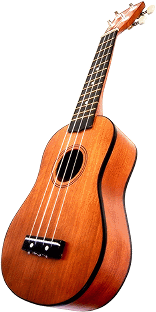
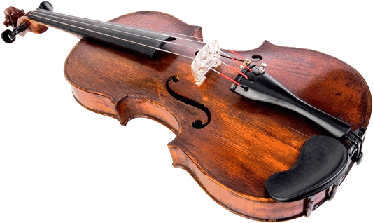
The Vidalita was a popular song, that was actually song. The video below doesn't have the chorus (I unfortunately couldn't find one with words) and is a little shorter than most versions of Vidalita. This song originated with the indigenous people, but became a popular base for bards and cantors, to which they would put their own words and stories.
For more history and descriptions on the vihuela, check out this site: http://cs.dartmouth.edu/~lsa/aboutLute/Vihuela.html
Have a great weekend everyone!

I like your 3rd blog!
ReplyDeleteVery interesting, Leah! Thank you for sharing :)
ReplyDeleteWell, I must say this is pretty cool! I liked the pictures you used in here, and the videos as well.
ReplyDeleteThis blog sort of made Sarmiento's work come to life. When reading his work, it can be very easy to see it as just a piece of paper with words on it, because music can't really be described on paper-- it needs to be heard out loud!
I also found your explanation of bridges and how they differ in certain instruments thought provoking. I never actually thought about how a bow plays one string at a time on a violin, but when you explained it, I could picture it and it made a lot of sense.
Last semester for my groups video project we used Mandie playing the piano as background music, and I think you should put some of the violin in your groups video project this semester!
Leah! That is really cool. I had no clue you enjoy music and play the violin and the cello. I also enjoy music and have been playing the trumpet for 8 years and just started the playing the guitar and love it. That first video is awesome, the way that guy strums is insane. I also never knew that about the bridge of the violin as well, but it makes complete sense! I really like how you found a sweet, musical video from a word that intrigued you in Sarmiento's reading. Thank you for sharing, Leah!
ReplyDeleteThank you so much for looking up some of the music we have been hearing about in our reading. I think music is a great cultural aspect that all countries have that makes them unique. It also helps break down barriers between people of all different races and ethnicities. All places have their own music, and like Sarmiento mentions when he writes about the Argentine and Chilean people, it allows people people to communicate without an actual language. Music has a way of separating people and making them unique, but also making connections were they would not always be formed.
ReplyDelete